Project planning and business assessment

We assess business goals, organize requirements, then produce clear briefs, plans and specifications for implementation. With project management experience, we help turn an idea into a transparent, plannable and executable project.

  • Requirements gathering, priorities and clarifying business goals
  • Specification, flow diagrams and implementation logic
  • Less uncertainty, better decisions before development
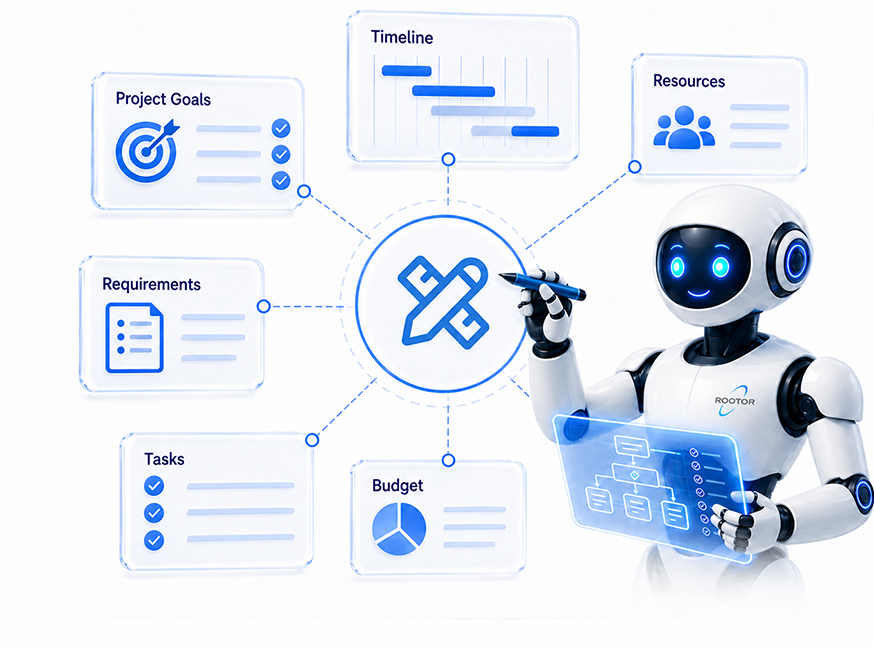
Project planning <span>and business assessment</span>

What does good project planning give you?

Project planning helps clarify the goals, features, user flows and implementation logic, so digital development is built on realistic foundations.

Goals and priorities

The first step of project planning is making the business goals, users and truly necessary features clear.

Specification and processes

An idea only becomes a well-executable project when the operation, user journeys and feature logic are also clearly documented.

Planning elements

Business assessment and project planning can be made up of various elements depending on requirements, from goal and requirements gathering to technical recommendations.

Goals and priorities

There's no good digital project without clear business goals

Many projects are already uncertain at the start because goals and priorities weren't properly clarified. A thorough assessment reduces this risk.

A successful digital project doesn't start with development, but with clear business goals and precise planning. Many websites, web applications or internal systems fall behind schedule because the initial requirements weren't properly clarified.

A thorough business assessment helps determine:

  • what the project's real goal is
  • who will use the system
  • which features are actually necessary
  • what technical and business constraints need to be considered
  • what timeline and budget makes sense to plan for

Specification and processes

The idea becomes a concrete implementation plan

The brief, the specification and the process description matter because they make implementation estimable and manageable. This way, development isn't built on guesswork.

It's not enough to simply state that a new website or online system is needed. The real question is how it should work, what steps make up the user journey, what data it handles, who it communicates with, and what result we expect from it.

During the project planning process, we organize requirements, prioritize features, and produce a brief or specification that makes implementation far more accurately estimable and manageable.

This phase can include mapping user flows, a sitemap, the system structure and the implementation logic.

Planning elements

What elements can a project plan consist of?

The planning phase isn't template-driven document production, but targeted preparation. The specific project's requirements determine what level of detail is needed.

Depending on requirements, the planning phase can be built from various elements:

  • goal and requirements assessment
  • feature list and priorities
  • mapping user flows
  • sitemap or system structure
  • technical recommendations
  • development timeline and implementation logic

This phase is especially useful when multiple stakeholders are involved in the decision, or when the project is too complex to launch based on brief discussions alone.

Request information — free, no obligation.

Fill out the form, and based on the information provided we'll get in touch with you shortly to find the best solution for your online system or web development project.

  • A personalized proposal
  • A free needs assessment
  • A reply within 24 hours
  • Contact in English
+36 1 300 9247
Your Details
Required field!
Required field!
Required field!
Message